Digital credentials
SCALE — verified, employer-visible skills
SCALE converts apprentice related instruction and on-the-job competencies into portable digital badges that employers can verify instantly.
How SCALE works
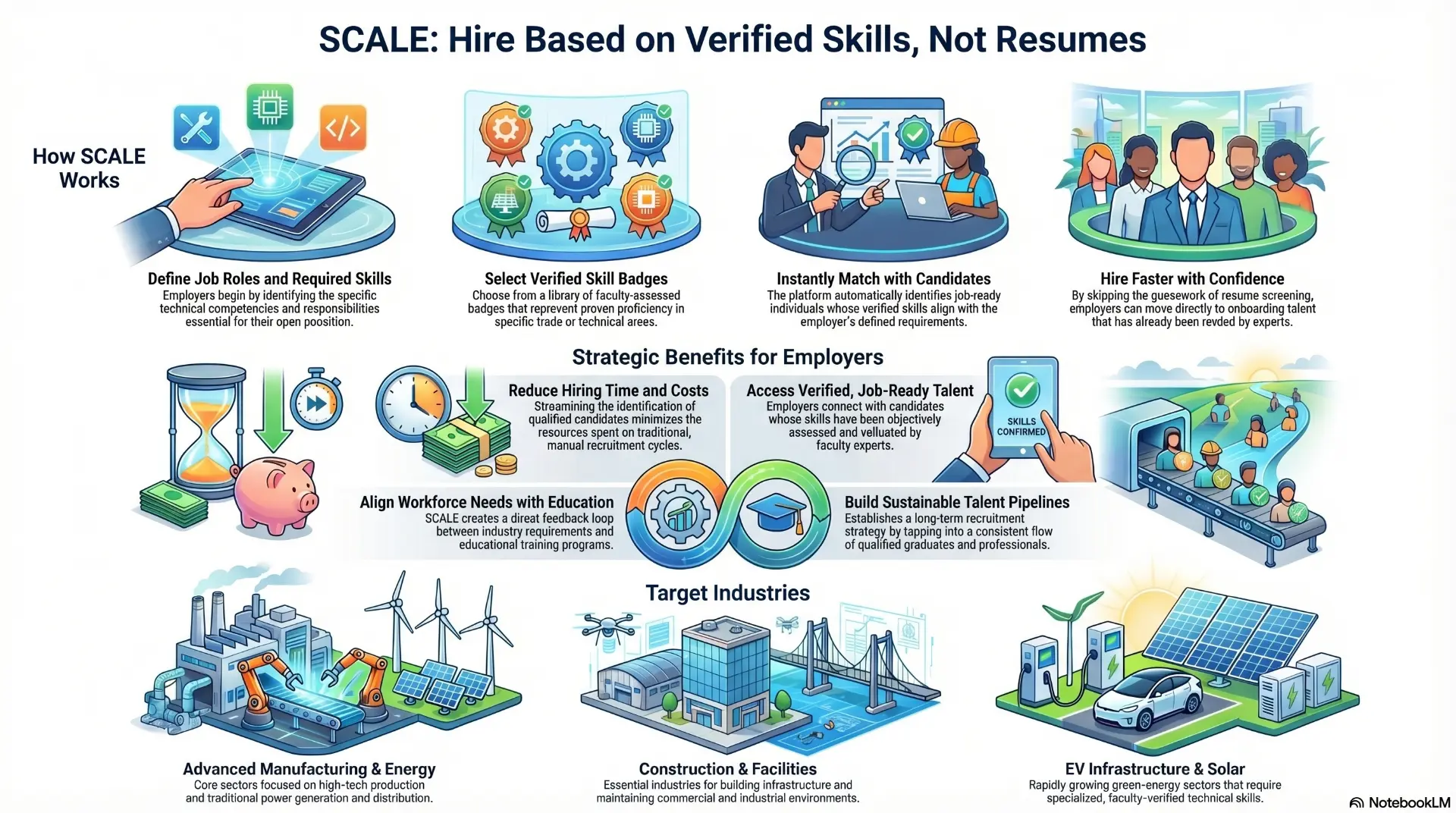
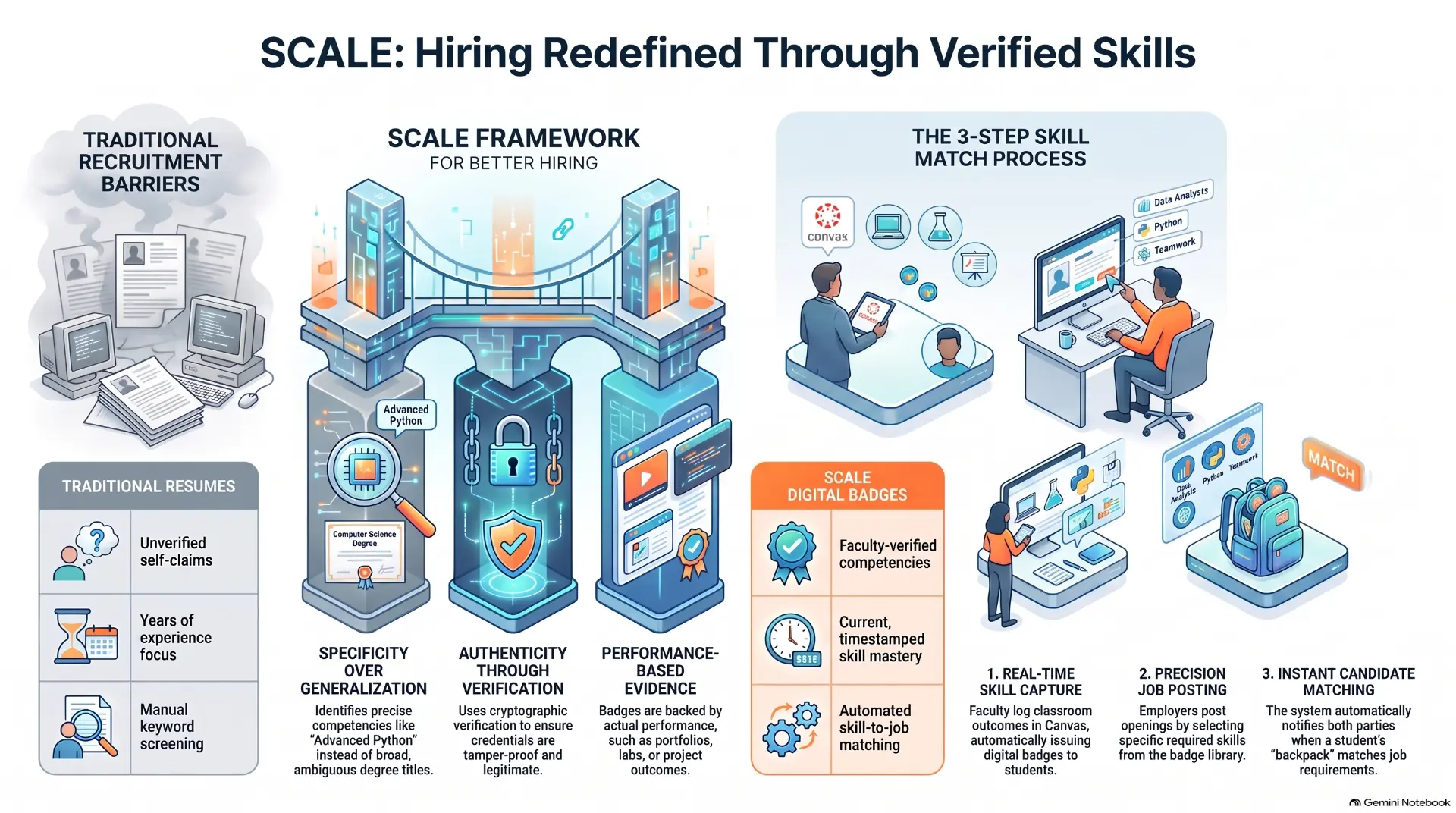
A short overview of the platform, plus a walkthrough of skills-based hiring — from defining a role to matching verified, job-ready candidates.
A regional project hosted by the Orange County Regional Consortium (OCRC) · Fiscal agent: Saddleback College
SCALE — Digital Credentialing Platform
Connecting students and employers through verified, skills-based micro-credentials.
SCALE is a Canvas Outcomes-to-badging platform that turns coursework into verifiable, portable digital credentials across the Orange County community college region. It is hosted by the Orange County Regional Consortium (OCRC) — the coordinating body for career/technical education and workforce development across Orange County's nine community colleges and one continuing education center — with Saddleback College serving as fiscal agent.
Developed with Strong Workforce Program (SWP) regional grant funding, SCALE runs on Canvas Credentials (Badgr/Parchment), connected directly to Canvas's grading and outcomes system.
At the heart of SCALE is an employer-defined, student-accessible database — a “Skills Cafeteria” — listing the specific competencies real employers use in their hiring criteria. As students master those skills through coursework, digital badges are issued automatically: every time faculty log a grade tied to a mapped skill outcome, that achievement becomes a verifiable, shareable credential — no separate assessment or paperwork required.
In apprenticeship contexts, SCALE tracks and validates RSI (Related and Supplemental Instruction) completion — the classroom instruction required alongside on-the-job training in a Registered Apprenticeship — converting apprentice progress into employer-visible micro-credentials in real time.
Benefits to employers
Recruit apprentices with confidence, not guesswork
Instead of transcripts that only show course titles and grades, employers see exactly which employer-defined skills a candidate has demonstrated — verified against criteria employers helped set.
See skill mastery as it happens
Badges are issued the moment a skill outcome is met, so employers get a live, evolving picture of a student's or apprentice's growing skill set instead of waiting for program completion.
Reduce onboarding and training risk
Competency-level credentials identify candidates genuinely ready for specific apprenticeship tasks or entry-level roles, reducing mismatches and shortening ramp-up after hire.
Track RSI completion automatically
For employers of record in Registered Apprenticeship programs, SCALE provides a transparent, verifiable record of RSI progress — supporting compliance reporting and reducing manual tracking.
Shape the curriculum-to-skills pipeline
Because the Skills Cafeteria is employer-defined, participating employers help determine which competencies are tracked and badged — reflecting what they actually hire for.
Lower-cost, higher-signal recruiting
Employers can browse verified skill profiles as a sourcing tool — more targeted and lower cost than broad job postings, especially for hard-to-fill technical and skilled-trade roles.
Benefits to students & apprentices
Get seen by employers while you're still learning
Every mapped skill you complete becomes a visible, shareable credential immediately — employers can discover your progress before you finish the program.
Turn coursework into proof, automatically
No separate portfolio or after-the-fact certificate application. As your instructor grades coursework against mapped outcomes, the credential is issued to you directly.
Make your RSI progress count toward your career
Registered apprentices convert Related and Supplemental Instruction into badge-based proof of competency for their employer of record and future employers — not just a compliance line item.
Build a portable, verifiable credential record
Badges live on your own credential record via Canvas Credentials/Badgr and can be shared with employers, added to a resume or LinkedIn, or presented in interviews.
Stand out earlier in your program
Credentials accumulate continuously rather than only at completion — useful for landing internships, apprenticeships, or part-time work while still enrolled.
Skills-first visibility, not just a degree title
Show employers the granular competencies behind your coursework — helpful for career-changers and students building toward a specific trade or technical role.
Benefits to colleges — Deans & Faculty
Higher enrollments from the incumbent workforce
As employers browse SCALE to fill existing or new positions, they see exactly which college courses deliver the skills they require. That visibility drives incumbent employees back into those courses to earn the verified badge — increasing term-to-term enrollments from working adults who previously had no clear path to a credential.
Curriculum mapped to real employer demand
Deans and faculty see, in one place, which employer-defined skills map to their courses. Where a gap exists between what employers need and what is taught, faculty can adjust outcomes — keeping programs aligned to the labor market without separate advisory-committee cycles.
Evidence for advisory committees and accreditation
Each badge maps a course outcome to a documented employer skill need, giving chairs and deans ready evidence of program relevance for advisory board meetings, program review, and accreditation reporting.
Employers discovering your programs
Employers entering SCALE to post jobs encounter the college's courses as the source of the verified skills they want — turning SCALE into a recruiting channel for the college's own programs and apprenticeships.
No added faculty workload
Badges issue automatically from the grades faculty already log against mapped Canvas Outcomes — no extra assessment, no extra paperwork, and no separate badging project for faculty to maintain.
How it works
- 1
Employers define the skills that matter for hiring and apprenticeship readiness — the “Skills Cafeteria.”
- 2
Faculty map coursework and grading in Canvas to those employer-defined skill outcomes.
- 3
Students complete coursework — including RSI coursework for registered apprentices.
- 4
Grades automatically trigger digital badges issued through Canvas Credentials (Badgr/Parchment) — no separate certification process.
- 5
Students share their verified credential record with employers, who evaluate real, employer-validated skill achievement.
Parchment & the SCALE platform — no campus IT burden
SCALE runs on Parchment's Canvas Credentials service, hosted entirely in the cloud. Colleges do not install, host, or maintain any software on their own servers, so there are no local infrastructure, security, or data-retention concerns for campus IT to manage.
Cloud-hosted by Parchment
The badging engine, credential storage, and employer-facing skills database all live in Parchment's cloud environment. No on-campus servers, databases, or backups are required, and the institution never stores badge data on its own systems.
One LTI connection — nothing more
The only technical integration is a single LTI (Learning Tools Interoperability) link from Instructure Canvas to the institution's local Parchment account. Campus IT approves one external tool connection; there is no software to install, no API to build, and no ongoing maintenance contract.
The LTI collects criteria, not student records
The LTI connection passes only active badge criteria from Canvas Outcomes so each criterion can be mapped to a SCALE badge carrying the same criteria. It does not transfer enrollment records, grades, or PII — only the competency definitions needed to align a Canvas outcome to a SCALE badge.
Criteria-matched mapping
Because the LTI carries the badge criteria, SCALE can match a Canvas outcome to a SCALE badge that shares identical criteria. When a student meets the outcome in Canvas, the matching SCALE badge is issued automatically — the college's real, official badge, visible to the student and the employer through Parchment.
In short: SCALE lives in the cloud, connects through one LTI link, and only carries criteria — keeping campus IT out of the credential-issuance business while the college retains full ownership of the badges it awards.
Sign up for SCALE
Employer signup
Name the HR department lead who will upload job descriptions and select the apprenticeship RSI courses or skills required for each position. Submitting automatically emails Dr. Jon Caffery with your details.
The SCALE badge catalog — SMaRTech
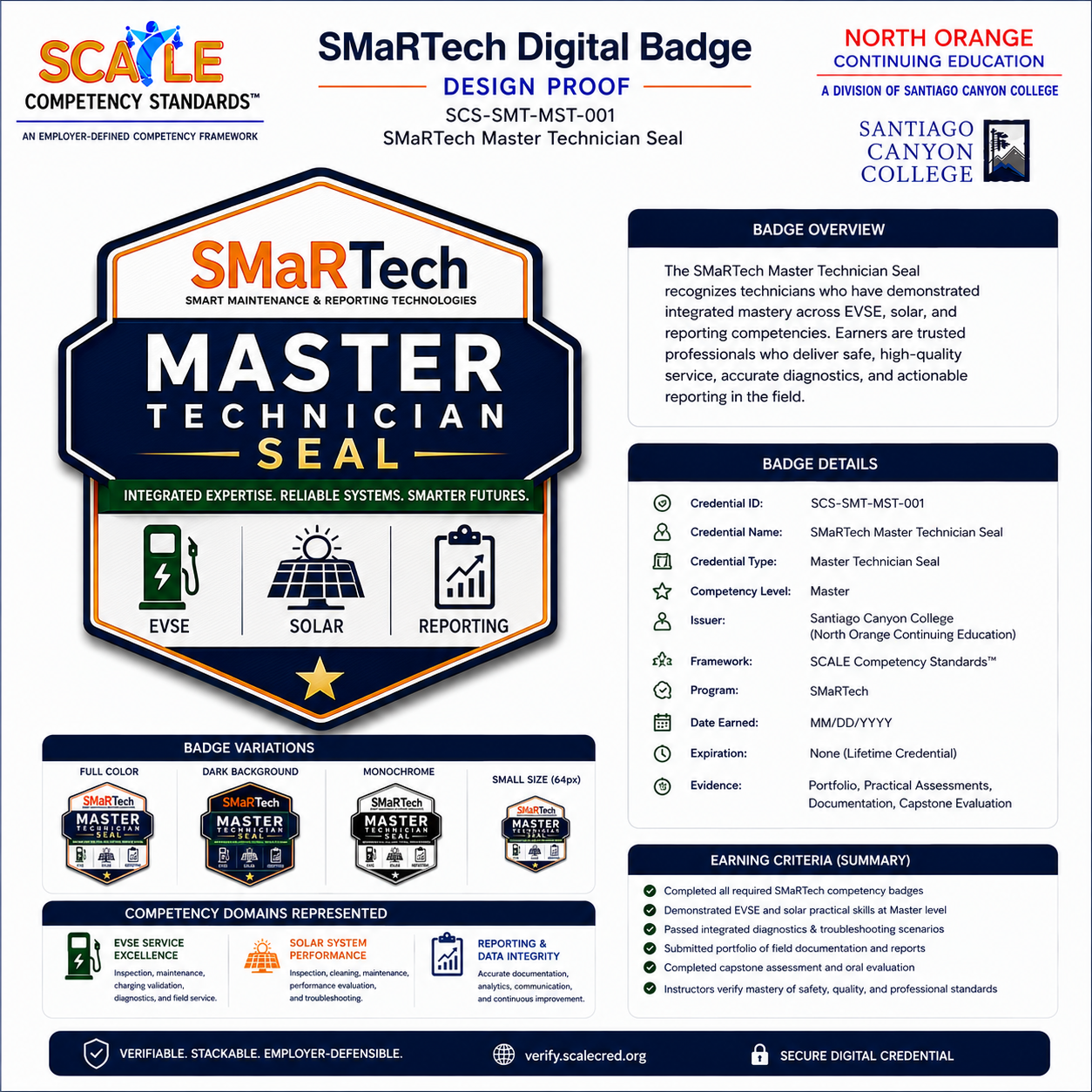
The SCALE Competency Standards catalog for SMaRTech includes 23 competency badges across three levels, plus the SMaRTech Master Technician Seal — a culminating recognition credential.
SCALE badges shown here are facsimiles — the college issues the real credential.
SCALE artwork represents an employer-defined competency standard. The official, verifiable badge is issued by the participating institution when the apprentice completes the related instruction and demonstrates the competency on the job. In this sample, the SMaRTech SCALE badges are mapped to the credentials issued by North Orange Continuing Education (a division of Santiago Canyon College).
Employers select a SCALE badge only when building a job posting — it defines the skill the role requires. That selection maps to the real badge at the participating institution. Once the student earns the institution-issued badge, both the student and the employer can see and verify it.
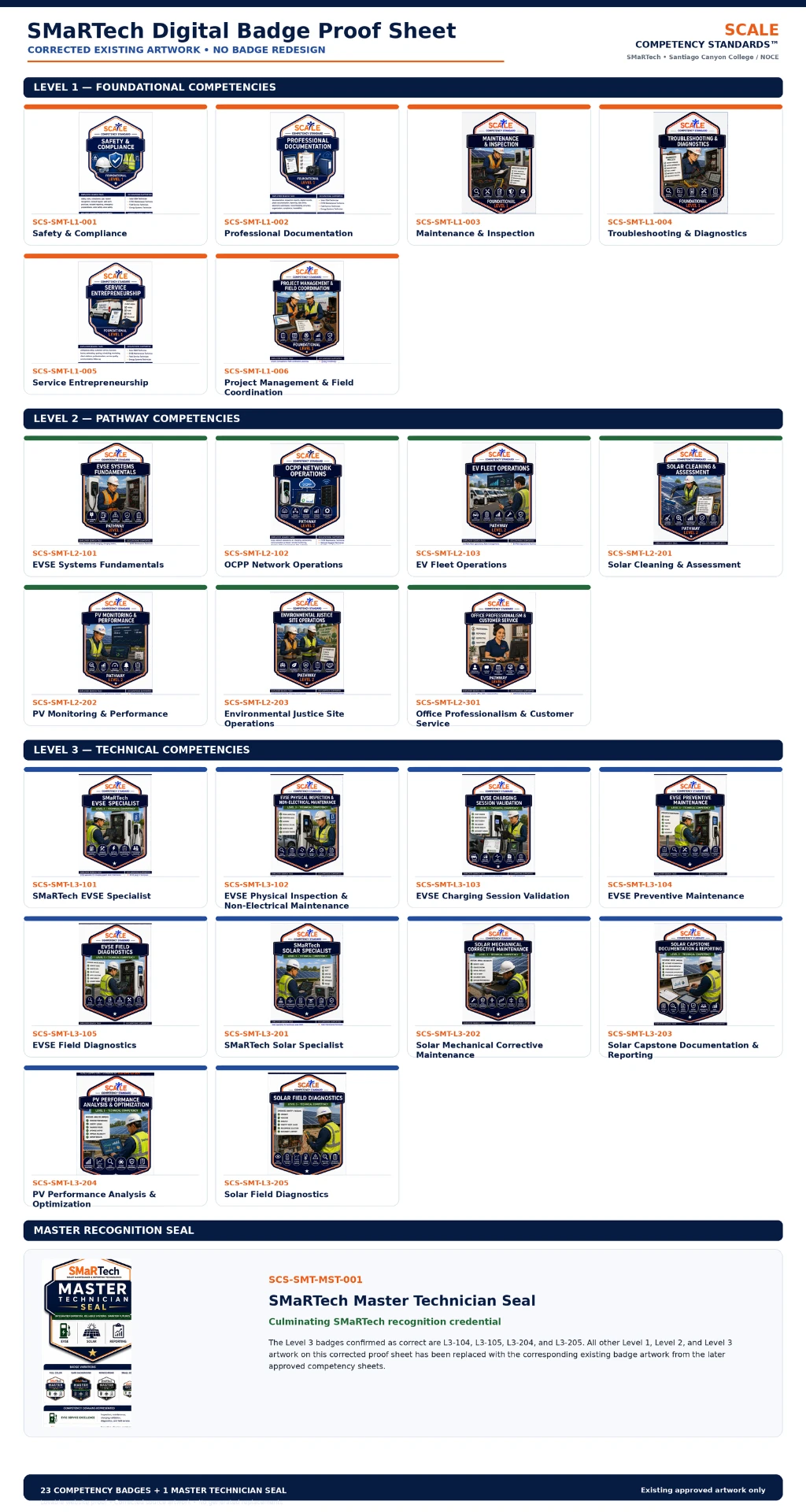
Level 1 — Foundational competencies
6 badges
- SCS-SMT-L1-001Safety & Compliance
- SCS-SMT-L1-002Professional Documentation
- SCS-SMT-L1-003Maintenance & Inspection
- SCS-SMT-L1-004Troubleshooting & Diagnostics
- SCS-SMT-L1-005Service Entrepreneurship
- SCS-SMT-L1-006Project Management & Field Coordination
Level 2 — Pathway competencies
7 badges · EV, Solar, Business
- SCS-SMT-L2-101EVSE Systems Fundamentals
- SCS-SMT-L2-102OCPP Network Operations
- SCS-SMT-L2-103EV Fleet Operations
- SCS-SMT-L2-201Solar Cleaning & Assessment
- SCS-SMT-L2-202PV Monitoring & Performance
- SCS-SMT-L2-203Environmental Justice Site Operations
- SCS-SMT-L2-301Office Professionalism & Customer Service
Level 3 — Technical competencies
10 badges · EV, Solar
- SCS-SMT-L3-101SMaRTech EVSE Specialist
- SCS-SMT-L3-102EVSE Physical Inspection & Non-Electrical Maintenance
- SCS-SMT-L3-103EVSE Charging Session Validation
- SCS-SMT-L3-104EVSE Preventive Maintenance
- SCS-SMT-L3-105EVSE Field Diagnostics
- SCS-SMT-L3-201SMaRTech Solar Specialist
- SCS-SMT-L3-202Solar Mechanical Corrective Maintenance
- SCS-SMT-L3-203Solar Capstone Documentation & Reporting
- SCS-SMT-L3-204PV Performance Analysis & Optimization
- SCS-SMT-L3-205Solar Field Diagnostics
SCS-SMT-MST-001 — SMaRTech Master Technician Seal. A recognition credential, not a competency standard. Awarded after all required competency badges, integrated EVSE and solar practical assessment, portfolio submission, and capstone evaluation.